Why is the well slow after restart?
Wax or asphaltene buildup can restrict flow, but a weak restart alone does not prove a blockage. Compare the last stable rates, pressure and lift readings with a comparable restart.
Screen the restart
EXECUTIVE OVERVIEW / SHEET 01
Screen a weak restart in a mature oil well. See when to investigate wax or asphaltene buildup and how to evaluate one candidate for treatment.
Prepare a one-well review
Conceptual cutaway, not to scale. It shows the intended mechanism, not a forecast for your well.
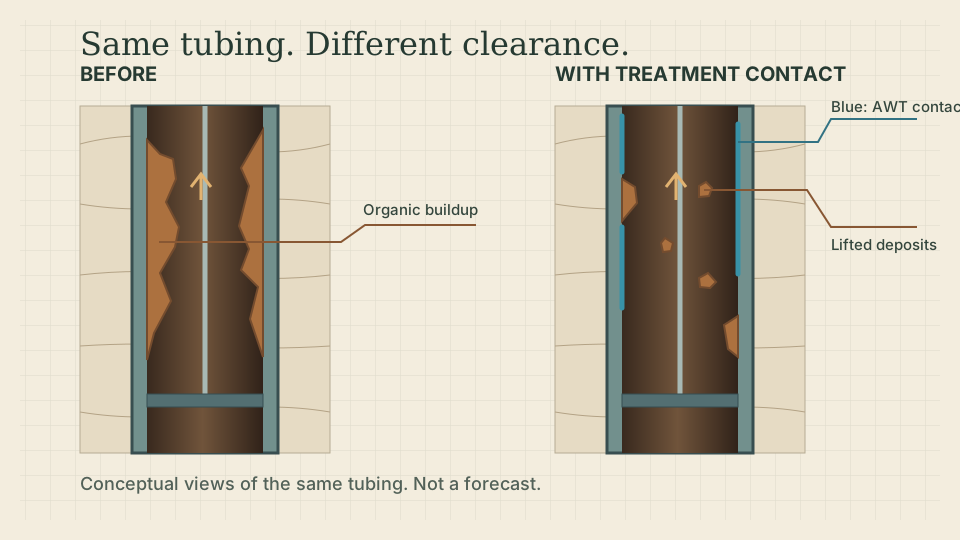
Illustrates how SolidsFree 432 is intended to mobilize organic deposits. Blue marks product contact, not a lasting coating or an application route. This is not a forecast for a well.
Wax or asphaltene buildup can restrict flow, but a weak restart alone does not prove a blockage. Compare the last stable rates, pressure and lift readings with a comparable restart.
Screen the restartAWT describes SolidsFree 432 as intended to mobilize organic deposits such as wax and asphaltenes. Its ALS Production Lubricant is primarily intended to reduce friction and drag at contact surfaces.
Compare the two product rolesAgree on a comparable baseline, an observation window and stop criteria before a one-well trial. Track oil rate and the relevant lift measurement, and document changes that could explain the result.
See what to bring to a reviewFROM THE FIELD
A weak restart, signs of buildup or rising load can justify a closer look. The next question is whether the evidence points to a recoverable restriction.

THE FIRST DECISION
The decline follows a shut-in, deposits are documented, or load rises without a clear mechanical explanation.
Mechanical failure, well integrity, reservoir depletion or excess water better explains the loss.
Bring the well history, lift readings and any deposit evidence. Agree on the comparison window, success threshold and stop criteria before treatment.
Start with a brief overview. Ask for a secure transfer route before sending confidential well files.
